Friday, May 11, 2012

The Limitations of Sense

As I've mentioned previously, I lived in the dorms in college.  In addition to balky vending machines, the dorms also had a number of loungescommon areas on selected floors for people to gather for the purpose of studying (if they didn't mind a bit of noise), watching TV, or generally screwing around.  And, from time to time, there was the occasional Bible study group.

I hasten to emphasize that the study group people (who generally lived in the dorms themselves) were very reasonable about their use of the lounge.  They were perfectly willing to wander around in search of a mostly unused lounge, and they asked the others instead of just plopping themselves down and using the space.  In my own turn, I was perfectly willing to move over to defrag the chairspace in the lounge and allow them their own section.

Once, though, they did manage to irritate me.

I had settled in with my Walkman, listening to an album.  (For the benefit of those of you who were born in this millennium: Songs used to be sold on physical media, called "vinyl" or "records."  These records could be "singles," or they could be multiple songs sold on one "album."  We had this innovation—developed by Sony, a company that existed even thencalled a Walkman, which played "tapes," on which songs could be transferred from the record.  It was called a Walkman because you could walk around with it.  You could listen to a whole entire album and not be tethered to your "component stereo system," which was a collection of devices used to play music at a time when computers had memory sizes measured in kilobytes.  We thought it was great.)

Anyway, the Bible group came in and said they wanted to use the lounge and they promised not to be too loud.  Since I was the only other one in the room and I didn't want to be a complete jackass, I cheerfully agreed and moved over to the other side.  But in doing so, I took off my headphones.  And so, as they began discussing the Bible, I listened to them.  It was interesting, after all.

After some time, however, I guess it became increasingly evident that I was listening to them, and since it was apparently one of their objectives to spread the word to as many people as they could, they began working on me.  Now, I was brought up without any religious background.  (Oddly, I do recall that we had a napkin holder that had some strange incantation on it about "daily bread," although that was never explained to me.  I had to find out about it on my own.  But that's a story for another time.  Essentially, there was no religion in my upbringing, at all.)

What's more, I had by this time become fascinated by science, and the scientific method.  I didn't have a firm idea, perhaps, of how science got done, exactly, but I did have the notion that people were fallible, and experiments were conducted so that we could find things out without relying solely on fallible humans.  And it seemed to me that the more fantastical stories in the Bible (as opposed to the moral precepts, say) simply would not stand up to any kind of scientific inquiry.  I did not believe that there existed anything like the Christian god.  And I'm sorry to say that, somehow, that came out.

Well, the floodgates opened up after that.  And I just could not get them closed back up.  For some reason, I was made to answer for the slightest failing or shortcoming of science as it pertained to anything, and I mean anything, in the Bible.  To be sure, I was not blameless in this; at that age, I had not learned to adopt the sort of detached self-doubt that I can effect these days, and I was unfoundedly certain about the points I made, which landed me in some hot water.

I don't remember how I managed to extricate myself from the "discussion," but I do know that it took a couple of hours, after which I went to my room and lay down.  I was exhausted.

A few of them came up to me the next day, and apologized for their aggressiveness.  I said I understood, and apologized for my unseemly certainty.  But it set me to thinking: I did feel pretty certain about my atheism.  Why?  What made me feel so certain?  I had some vague sense that it had something to do with a kind of epistemological conservatism (though I wouldn't have known to put it in such a way)the idea that one believes in as few things as is possible to understand the world—and the proposition that extraordinary claims require extraordinary evidence.

It took me some years, however, before I could fully work out what my situation was with regard to atheism, and agnosticism, and all that.  It came about like this:

Much later, I was talking to this fellow, and I mentioned some of this mess I got in with the Bible study group.  And so he asked me, what did make me so certain?  He thought that people who could feel so certain that there was no god were just as scientifically irresponsible as those who could feel certain that there was one.

Fortunately, by this time, I had read Wittgenstein (I'll bet that's the only time you'll hear anyone consider it fortunate to have read Wittgenstein, and by the way, he looks just about that crazy in every picture of him I've ever seen), and I knew he had, too, so I could express it a bit more concisely.  I said that I was about as certain that there was no god as Wittgenstein was that he had a hand.  What good ol' Wittgensteinand I, by extensionmeant by that was that the knowledge that one has a hand represents an upper limit of certainty: a limit imposed by our senses.  We know it not because it is logically proven beyond a shadow of a doubt, but because doubt itself is pointless in this regard.  In other words, the degree to which we know it is a milestone of certainty—in a very real sense, defines it.  In fact, I think Wittgenstein says as much, right at the very start of his final work, On Certainty:
If you do know that here is one hand, we'll grant you all the rest.
My friend was satisfied by that, I believe, and he walked away.  As he walked out, though it hit me that that was it—that the limitations of my senses were the basis of my "certainty" that there was no god.

To begin with: From time to time, some atheist wag will remark that we have no more evidence for the existence of the Christian god than we do for, say, the Flying Spaghetti Monster.  Which is true, so far as it goes, but it doesn't really establish atheism (the belief that there is no god) as it does agnosticism (the lack of a belief that there is a god).

So then, the hypothetical line of questioning goes, what would it take to establish the existence of a god in any kind of scientific way?  Because, as I tell others, if you take a position against something, then as a self-check, you must ask yourself what it would take to convince yourself you were wrong.  Because if there's no amount of evidence that would do it, then your position isn't a scientific one; it can't be falsified.

I thought about all the miracles that are said to be the work of some god or another, all the things that happened that could not be explained.  In most cases, I rather thought that these were evidence less for a god than for the selective ingenuity of humans: If people wanted to believe in something, they were remarkably ingenious about how they managed to assemble evidence in its favor.  But if they didn't want to believe it, that ingenuity mysteriously went away.  In other cases, I couldn't come up with a plausible explanation, except to say that the people who related these stories (thousands of years ago, remember) were either mistaken or, possibly, exaggerating.  That might not have satisfied anyone who was truly on the fence, but it satisfied me.

It boiled down, therefore, to what I could personally witness that would convince me I was wrong.  What could a supernatural being do that would sway me?  It quickly occurred to me that whatever evidence could possibly support the claim to existence of a god had to be much more extraordinary than the possibility that my senses were fallible.  When it came to the existence of a god, I could not grant that I had a hand.

We hear "Seeing is believing," but we see things all the time that, it later turns out, aren't true.  And so, not as an expression of any desire, but simply as an acknowledgement that my senses can fail, catastrophically at times, I flatly admit an incapacity to believe in a god, any god (as normally represented—I obviously don't mean just a super-powerful being, but someone who brought about the world).  It's a personal incapacity, not one that I could possibly extend to anyone else, but it's insuperable just the same.

Sunday, April 15, 2012

If It's Negative in Area, Do I Get a Refund for Buying It?

I realize this is mostly crazy on my part, but honestly, I really wish real estate people would stop using the plus-minus sign (±) in this jackass way.

Sunday, April 1, 2012

The Tip of the Iceberg

A couple of weeks ago, as I write this, Dharun Ravi was found guilty of invasion of privacy and a host of other charges in a sequence of incidents, including spying via webcam, that ultimately culminated in the suicide of his roommate Tyler Clementi (left).  Ravi faces up to ten years' imprisonment, and deportation to his native India.

Now, since it's been a couple of weeks, a lot has already been written about whether or not Ravi was culpable, whether others had a role, what it says about us as a society that we continue to demonize and ridicule homosexuality (or conversely, what it says about us that we are able to demonize and ridicule someone for being a peeping Tom and a loudmouth).  I'm not going to say anything about that.  As is my wont, I'm going to talk about statistics, but with an eye toward how we perceive events like this.

In a way, those who wonder how we can hound Ravi the way we do have a point, even if I disagree with their larger perspective: What Ravi did, as wrong as it was, is probably happening all over the country—or the world—as we speak.  Is Ravi wronger because what he did led to Clementi's suicide?  Should he, in effect, be the scapegoat on which we place all the otherwise indistinguishable wrongs that, by sheer dumb luck, resulted in nothing more than a change of roommates?  I've been following the Ravi/Clementi case for a few months, after Clementi's suicide but before the trial began, and I seem to recall that Clementi did in fact look into switching rooms, but for whatever reason did not manage to do so before his death.  If he had changed rooms, where would we be now?  Would we be up in arms about homophobia and scapegoating?

This is only part of a general problem that human beings have with assessing rare events.  To be sure, it's not simply a matter of placing too great an emphasis on the result of those events, although we do do that.  (Many of us greatly fear the rare airplane crashes, even though they are at least an order of magnitude safer than road travel by practically any metric you care to choose.)  More than that, it's that we just do not have the vocabulary to compare these rare events, and their consequences, with their more typical brethren.

Interestingly, we don't really run into significant roadblocks with their opposite number, the rare non-events.  If someone intentionally shoots a bullet into a crowd, and against incredible odds, manages to hit no one at all, we still find them guilty of reckless endangerment.  The rare non-homicide doesn't conceal from us from the essential wrongness of the act.

But Ravi's case, and others like it, put us in a quandary.  Despite what others have said, I don't believe what Ravi (right) did led inevitably to Clementi's suicide.  We tend to think so because Clementi did in fact die, and what Ravi did is reprehensible and did in fact lead materially to Clementi's death.  But to think that it was the unavoidable outcome of what Ravi did is to assume that his actions are as rare as Clementi's suicide, that whenever this kind of thing happens, we will hear of it.  This strikes me as burying one's head in the sand.  It's not appealing, because many of us really do want to blame Ravi, but one can't consistently believe both that Ravi inevitably caused Clementi's suicide, and that their situation is common. 

But if the opposite is true, and similar situations are playing themselves out all the time (just with much lighter consequences), then what are we, as a society, to do with Ravi?  What are we to do with anyone who does something criminal that then leads, against (let us say) hundred-to-one odds, to someone's death?  Ostensibly, their actions put them in a lottery of sorts.  We punish the lottery losers, and everyone else goes unscathed, perhaps even unnoticed.

Is this justice?  Does the punishment really fit the crime, or is it more that it fits the consequences?  If it fits the crime, what should we do about those who do not lead to any substantive damage?  On a more abstract level, are we doing what we should to protect potential victims?  Even from the point of view of American jurisprudence, in which the results matter, the situation is unclear.  By throwing the book at Ravi, and missing the others, do we send the message that what Ravi did was wrong?  Or do we just send the message that one just needs to avoid getting caught?

Someday, perhaps, situations like Ravi/Clementi will cease to happen.  It seems unlikely to me, but just perhaps!  But in the meantime, we must think hard about the consequences of punishing people for the results of their crimes, when those results are rare.

Wednesday, March 14, 2012

No Two Alike

Another meandering post.  You've been warned.

I'm re-reading Isaac Asimov's informal autobiography, I. Asimov (a play on his collection of robot stories, entitled I, Robot, and to be distinguished from his formal autobiographies published earlier in his life), and finding it quite entertaining.  Partly, this is because I'm an inveterate re-reader and re-watcher.  My enjoyment of a piece of writing or a movie or a TV program doesn't diminish because I know how it goes.  If I enjoyed it the first time, I'll enjoy it just as much the seventh time, or the fifty-seventh.  Even a sporting event isn't diminished because I know how the final score (although I do prefer to watch it live the first time, if I can).  All this just by the way.

Anyway, in this book, Asimov mentions his facility at giving impromptu talks, and mentions by way of illustration that he has given a couple of thousand talks, no two exactly alike.

And that phrase, "no two exactly alike," is so characteristic of snowflakes that I immediately thought of them.  In fact, I'd go so far as to wager that if you asked people what the first thing was that they thought about snowflakes, it would be that no two are alike.

But is that actually so?  Have there really never been two snowflakes alike?  If you're like most people, you'd probably just as soon leave well enough alone and assume it's true.  For the heck of it, though, take a trip with me down the rabbit hole.

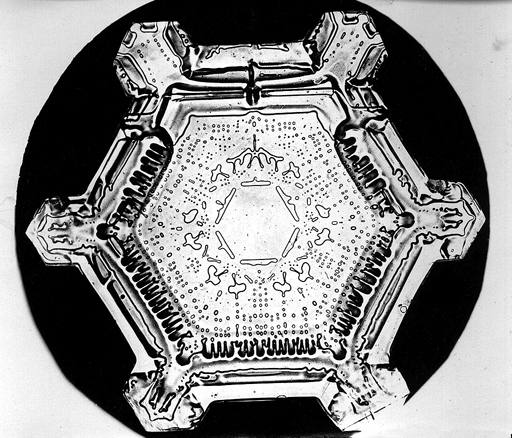
The whole idea that no two snowflakes are exactly alike has been around for time immemorial, but things really got moving with a man named Wilson Bentley (1865-1931), who grew up in Vermont.  When he was fifteen, his mother gave him an old microscope to experiment with.  Well, Vermont winters being what they were, I suppose it's natural that Wilson should have been drawn to snowflakes.  And so he took to maneuvering snowflakes under his microscope and sketching them.

It turned out, however, that they melted quickly—far too quickly for him to sketch in time.  So Bentley assembled a contrivance, a camera attached to a microscope attached to a board covered with black velvet, which permitted him to take pictures of the snowflakes before they melted.  Over his lifetime, he took images of over five thousand snowflakes, and sure enough, no two of them were exactly alike.

Five thousand, though a lot to take pictures of, is still a minuscule fraction of all the snowflakes that ever were, or even of those that are currently in existence (a constantly changing population, to be sure).  Surely there is no way that we could possibly take pictures of all the ones that currently exist, let alone those that have ever existed.  Is there perhaps another way to answering the question?

Consider: Each year, a substantial portion of the Earth is hit by snowstorms sufficient to dump several meters of snow on the ground.  I'm not sure of my statistics, but we probably wouldn't be far off if we assumed that the total annual snowfall amounted to a depth of, let's say, two tenths of a meter over the entire surface of the Earth, if it was spread around evenly.  Since the surface area of the Earth is about 5×10^14 square meters, we're talking about 10^14 cubic meters of snow.  When packed tightly (tightly enough to crush them), snowflakes might occupy a cube about a tenth of a millimeter on a side.  So each year, we get something like 10^26 snowflakes.  Taking into account the fact that there has been snowfall for a few billion years, there have been perhaps 10^36 snowflakes, ever, in the Earth's history.  That's a lot of snowflakes.

However, there are also lots of different shapes that any particular snowflake might take on.  Snowflakes exhibit six-fold symmetry because they're constructed from ice crystals, which have six-fold symmetry.  (You can find a picture of one in this article.)  So let's represent a snowflake as a hexagonal lattice, a bit like a honeycomb of cells, each of which might be occupied by an ice crystal, or not.  An individual hexagonal ice crystal is a few tenths of a nanometer across, whereas an entire snowflake might be a few tenths of a millimeter across.  So the hexagonal lattice representing our snowflake would have a diameter of about a million cells, and would contain about 750 billion cells in all.

Does that mean that there are nearly a trillion possible snowflakes?  No, because each one of those cells could either have an ice crystal, or not.  We could represent the snowflake by filling each one of those cells with a 1 if it had an ice crystal, or a 0 if it did not.  In other words, each snowflake would be represented by a huge binary number with 750 billion digits.  Such a tremendous number is on the order of 10 raised to the 230 billionth power.

It's hard to overstate how big a number this is.  Even if you were, somehow, to write a 100 digits a second, every second of every hour of every day, without interruption for sleep or eating, you have perhaps only an even-money chance of just writing this number out during your entire lifetime.  It goes without saying that it's much, much, much larger than 10^36.  (It is, however, much smaller than a googleplex.  I just thought I'd point that out.)

However, we're not playing quite fair, because we've completely neglected the symmetry exhibited by most snowflakes.  If we take that into account, it turns out that the number of possible snowflakes drop to something more like 10 raised to the 40 billionth power.  Quite a bit smaller, but still much larger than 10^36.

There's another thing, too.  Bentley took his photographs with an optical microscope, which was of course incapable of resolving ice crystals down to the individual molecular level.  These days, we're now capable of doing that, but it would be unfair to insist that snow crystals, which in an ordinary atmospheric environment would be constantly changing anyway, be identical to that level of precision.  A typical photograph of a snowflake might be able to resolve crystals to a level of detail that would take a hundred thousand cells to fill the entire snowflake.  Remembering to take into account the symmetry of snowflakes, there could still be on the order of 10^5,000 different snowflakes, at this reduced level of resolution.  Still much larger than 10^36.

OK, how about this?  If one looks at an array of Bentley's photographs, one notices that the ice crystals are not arranged haphazardly around the snowflakes, even after one takes into account the six-fold symmetry.  Instead, there is order at all different scales.  In fact, people have likened snowflakes to fractals; there are even simulations of snowflake generation that build upon the fractal arrangement.

That reduces the level of variation accessible to the snowflake.  It's hard to say for sure, but in most of the Bentley images, I think one can make out about six levels of detail.  (That's consistent with a scale ratio of about two to three.)  What's more, each unit of detail has within it detail that only goes about three or four levels down, which means that each level can be represented using about fifty bits or so.  That means a total of three hundred bits might suffice to denote a snowflake to the level of precision needed to figure out whether they match or not.  That would still mean about 10^90 distinct snowflakes, though.

All right, one last thing, which at first will seem to be a significant digression.  There is, in probability, something called the birthday paradox, which goes something like this: Suppose you get fifty otherwise randomly selected people together in a room.  What are the odds that at least one pair of them will share the same birthday (possibly different year)?  One in four?  One in ten?  How many people do you think you need to make the odds even?  Would forty do it?  How about sixty?  A hundred?

The answer, surprising to most people who haven't heard this question before, is that the odds are about even that out of just 23 people, at least one pair will share a birthday in common.  It's a bit surprising because there are 365 days in a year (not counting leap day), but consider what happens if you choose the people one by one.  The first, of course, can have any birthday at all.  In order to avoid a pair sharing the birthday, the second must not share a birthday with the first.  The third must avoid sharing a birthday with both the first and the second.  The fourth must avoid sharing a birthday with the first, the second, and the third.  And so on.  By the time you get to 23 people, there are about 250 birthday sharings that must be independently avoided.  It's not surprising that such sharings are avoided only half the time.

It turns out that this "paradox" (not truly a paradox at all, naturally, but just a counter-intuitive result of probability theory) has very wide applicability.  The number of samples that can be randomly selected before you stand a good chance of getting a pair is much smaller than the total number of choices.  In fact, it's on the same order as the square root of the number of choices.  (There's that square root again!)  The square root of 365 is a bit over 19, and sure enough, 23 isn't very far over 19.  If one takes into account the year of birth over the course of a century, then there are about 36,500 different birthdates, but the square root of 36,500 is only about 191, so that only about 200 randomly selected people are needed before you have a good chance of matching the entire birthdate.  And the square root of 10^90 is 10^45, so the size of the collection of snowflakes you need to have a good chance of pairing two of them is about 10^45.


It's more than 10^36, but not much more.  (What's a factor of a billion between friends?)  And there are a lot of back-of-the-envelope manipulations in what I wrote, so perhaps there are other deeper symmetries to take advantage of.  But I think it's rather magical that the numbers work out nicely so that it's quite possible that somewhere, across the vast mists of time, there were at (probably very different) points, two identical snowflakes!

Wednesday, February 15, 2012

Slip Sliding Away

Here's a counter-sliding game I came up with a while back, while visiting my parents.

My parents have these small flags of various countries, which can be stood up, UN-style, because they're on flagpoles that are stuck into circular bases.  The flags can be removed from the bases to be waved, and when they are, you're left with just the circular bases.  One day, while idly sliding them around the table, I thought about using them for various geometrical exercises.  Of course, if one doesn't have small circular flagpole bases, one can use any kind of equally sized circular tokens; any kind of circular coin should work just fine.

The rules I set up for myself were as follows:
  1. One starts out with two touching counters.  This counts as two moves.  (For "historical reasons.")
  2. On any subsequent move, one may add a counter; this counter must touch two existing counters on the table.  (There is an exception, which I will mention later, in connection with an outstanding puzzle.)
  3. Or, one may remove a counter.  One must remove the counter by sliding it, however, not by lifting it up off the table.
The following picture shows an example.


Here, counters 1 and 2 are placed first.  One may then place counters 3, 4, and 5 in that order.  Removing counters 3 and 4 then leaves a straight line of three counters.  One could not construct that straight line directly, by just putting down counters 1, 2, and 5, because counter 5 would not have been placed in contact with two counters.

One could continue twice more around counter 2, creating a filled hexagon of seven counters.  If, however, one wanted to create a hollow hexagon, one would have to remove that middle counter at some point.  It seems tempting to place one more counter below counters 2 and 5, and then remove counter 2 to place at the last corner of the hexagon, but the following diagram shows why that won't work:


The space between the two counters is not wide enough to fit the center counter through (in fact, that space has a width only √3 - 1 = 0.732+ times as wide as necessary), so it cannot be slid out in accordance to Rule 3, above.  You might like to see if you can figure out a solution for the hollow hexagon before reading on.

The trick is to set up support for the fifth corner first, then slide out the center counter to become the fifth corner; the sixth corner is then easily slid into place.  Begin by placing six counters in a parallelogram arrangement:


Then slide counter 2 to touch counters 4 and 6:


Now slide counter 4 into the place previously occupied by counter 2:


Finally, slide counter 1 around to touch counters 2 and 4, at the sixth and last corner of the hexagon.  Voilà!


I leave you with two puzzles, one fairly simple, and one open (that is, unsolved):
  1. Follow the above rules to construct a hollow triangle of side 4 (just like the arrangement in ten-pin bowling, but without the center pin), in as few moves as possible.  There is more than one solution.
  2. Suppose we add an exception to Rule 2, above: We permit a counter to be placed in an arbitrary location on the table, but with the proviso that no required property of the final arrangement can depend on the exact location of that counter.  (For instance, a construction of a rectangle that depends on a counter being placed somewhere between 1 and 2 counter widths away from another is OK, but one that depends on it being placed exactly 1-1/2 counter widths away is not.)  In that case, is it possible to construct a perfect square of four counters, of any side length?  The sides of the square need not be filled in with any counters.

Monday, February 13, 2012

Weighted Fair Division

I'm sure this is an old puzzle somewhere in the world, but it came upon us a few years ago here at work in connection with driving to lunch.

Where I work, the company provides a cafeteria where one may purchase lunch.  Unfortunately, the lunch is either too expensive or not good enough, depending on your point of view, so we generally eat out.  We're lucky that we can do that.  Anyway, in general, we try to take turns driving so that we're all likely to drive about equally often.  It doesn't always work out that way, but that's the aim.

If we all ate out every meal, it'd be simple; we'd all drive with equal probability.  But what happens if, as has been the case occasionally throughout the years I've worked here, one of us can only eat out once per week?  How often should that person drive, when they do eat out?

To make things simpler, let's assume that there are two of us daily diner (five times per week), and one single-day diner.  Four days out of the week, there are only two diners.  If each one drives one-half of the time, then both of them end up driving two days out of the four.

On the last remaining day of the week, when there are three diners, should each drive one-third of the time?  Well, if we do things that way, then each of the two diners drives 2-1/3 days, on average, whereas the single-day diner drives just 1/3 day per week, on average.  That's not fair, because the two daily diners drive seven times as much as the single-day diner, even though they only eat five times as often.  The single-day diner should have to shoulder more of the driving burden on that one day.

Let's denote by p the probability that the single-day diner drives on that day.  Then the two daily diners drive on that day with probability (1-p)/2, and over the course of the week, they drive (5-p)/2 days, on average.  According to our fairness metric, we must find p such that (5-p)/2 = 5p, which yields

5-p = 10p

11p = 5

p = 5/11

So the single-day diner should drive nearly half of the time, on those days when he or she joins the two daily diners.  By a similar line of reasoning, if there are three daily diners, that probability drops to 5/16, and in general, with n daily diners, the probability is 5/(1+5n), with each of the daily diners driving five times more often, or 25/(1+5n).

What happens if there are m one-day diners (each of them eating on the same day)?  Then the probability p that any of the one-day diners should drive on that one day drops even further, to 5/(m+5n).

One might well consider (providing one is still reading) extending these to k-day diners, and whether the results depend on the k-day diners eating on the same k days, or if the results are insensitive to the distribution of those k days.

Tuesday, February 7, 2012

Roll Over, You Pats!

This past weekend's Super Bowl XLVI (that's forty-six) provided yet another confluence of probability, tactics, and sports.  That's never a bad thing.

I'm speaking, of course, of the decision on the part of Patriots coach Bill Belichick to permit the Giants to score on second down and goal from the Patriots' six-yard line, with about a minute left in the game.  The Patriots put up only token defense, so that when Ahmad Bradshaw took the handoff from Eli Manning, he was able to waltz into the end zone.  Almost literally: Bradshaw had a moment of indecisiveness as he reached the one-yard line, but soon backed into the end zone for the touchdown.

Even before that play began, color commentator Cris Collinsworth had already suggested that the Patriots might permit the Giants to score easily, because the Patriots only had one timeout remaining.  They would therefore be able to stop the clock after second down, but not after third down.  Since the play clock starts at forty seconds once the ball is set, the Giants would attempt a field goal on fourth down with only about ten to fifteen seconds remaining on the game clock.  Collinsworth reasonably contended that the Patriots should prefer trying to score a touchdown with a minute left (plus their one timeout) over trying to score a field goal with ten to fifteen seconds left (without any timeouts).

(It's worth pointing out that then-Packers coach Mike Holmgren had been roundly criticized for making a similar tactical decision fourteen years earlier, in Super Bowl XXXII against the Broncos.  Times change.)

And now, once Bradshaw had scored, Collinsworth decried Bradshaw's touchdown as a tactical error.  Well, setting aside the tendency of sports broadcasters to exaggerate practically anything, was it a tactical error?  Which outcome is better for each team?

Well, first of all, there's the intuitive argument that if one team wants you to do something, then your best strategy ought to be to resist that.  So if the Patriots are parting the Red Sea, maybe your best bet is to lie down.  And indeed, the Giants had considered that.  Manning later reported that he was telling Bradshaw to go down in the field of play.  The Patriots, for their part, said that it was immaterial, that they would have shoved Bradshaw into the end zone, but that tactic would not have worked if Bradshaw had taken a knee: Any subsequent bump by a defender, even the lightest touch, would have made Bradshaw down by contact at the one-yard line.

But let's not let psychological ploys decide the question.  Which tactical choice is the right one here?

The Patriots have two choices—allow the touchdown, or play straightforward defense—but there are more than two possible outcomes.  If the Patriots play defense, there are still multiple possibilities:
  • The Giants might score on second down anyway.
  • Or they might score on third down.
  • Or they might score a field goal on fourth down.  (We'll assume they wouldn't try to score a touchdown.)
  • Or they might fail to score at all, either because of a turnover or a missed field goal.
If the Patriots allow the touchdown, and we assume for the time being that the Giants don't refuse that touchdown, then the Patriots would have to score a touchdown in about a minute, with one timeout remaining.  Let's say they're able to do that with some probability qTD.

On the other hand, if the Patriots play defense, then there are those four possibilities:
  • If the Giants score on second down, the Patriots still have to score a touchdown with about a minute remaining, and one timeout.
  • If the Giants score on third down, the Patriots have to score a touchdown with about a minute remaining, but no timeouts.
  • If the Giants score a field goal, the Patriots have to score a field goal with ten to fifteen seconds left, and no timeouts.
  • If the Giants fail to score at all, the Patriots can simply run out the clock.
If the Giants score on second or third down against straightforward defense, the Patriots are left in pretty much the same situation as if they just let them score on second down, modulo that timeout.  So as it stands, they're just a bit worse off if they play defense.

Now let's take a look at those last two cases.  If they don't score on second or third down, the remaining possibilities are a turnover, a missed field goal, or a made field goal.  Out of those, I'd guess the made field goal happens nineteen times out of twenty.  In the remaining cases, the Patriots just have to sit on the ball, which I'd also guess would happen nineteen times out of twenty (remember, they might have to avoid the safety).  So the question roughly boils down to, which is more likely: Scoring a touchdown in a minute, or one of the following happening—scoring a field goal in ten to fifteen seconds, securing a turnover, or the Giants missing a field goal?  If it's the touchdown, the Patriots should let the Giants score.  If it's any of the remaining three choices, they should play straightforward defense.

Given that Lawrence Tynes hadn't missed a field goal of thirty yards or less in forever, the Giants were going to play possession football, and the Patriots would have no timeouts left for a field goal attempt, I'd go with letting them score, just as Belichick did.  But there's no way this is a foregone conclusion.  Sometimes, it's just a close call.